
RFID Knowledge Centre
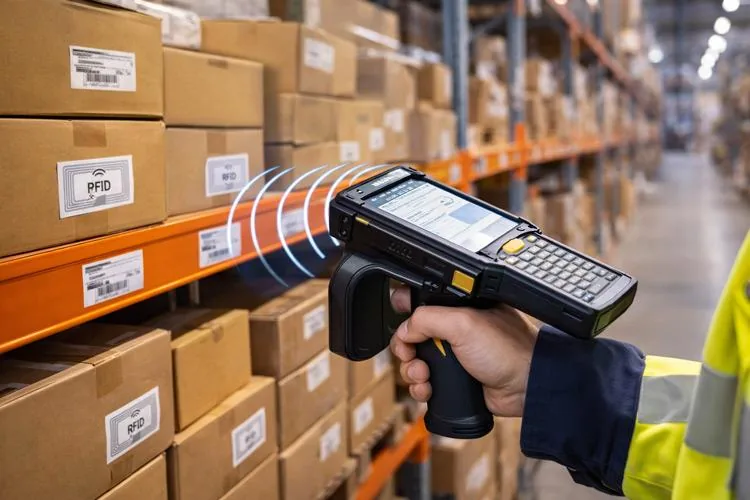
A plain-language introduction to RFID for business decision-makers.
What this covers
- RFID fundamentals RFID uses radio waves to read an identifier stored on a tag. Unlike barcodes, tags can often be read without line of sight and several can be read at once.
- Passive vs active RFID Passive tags have no battery and are powered by the reader’s signal; they are small, low-cost and common in inventory. Active tags carry a battery and can transmit further, which suits selected asset applications.
- RFID frequency bands Low frequency (LF), high frequency (HF) and ultra-high frequency (UHF) bands behave differently in range, speed and interaction with materials. UHF is widely used for inventory and logistics; regulations vary by country.
- RFID tags and readers Tags come as labels, hard tags and specialty formats. Readers are handheld or fixed. Choice depends on the item, surface material and read environment.
- RFID antennas Antennas shape the read zone. Placement, orientation and power settings strongly affect read reliability.
- RFID scanning workflows Common workflows include tagging at source or receiving, reading at doors or portals, handheld cycle counts, and verification at dispatch.
- RFID integration RFID readers pass data to middleware or software, which links tag IDs to item records and can update ERP or warehouse systems.
- RFID deployment considerations Test with real items and in the real environment first. Metal, liquids and dense packaging can affect reads. Plan tagging processes, training and support.
- RFID applications by industry Retail stock counts, manufacturing material and WIP identification, warehouse receiving and dispatch, equipment and asset tracking, and healthcare equipment visibility.
Ready to talk about your requirements?
Tell us what you are trying to achieve and we will help you explore the right approach.
Request an RFID Consultation